

4CS
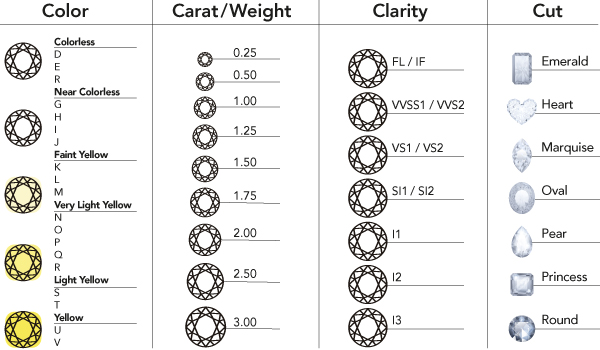
The 4Cs originate from the four English terms colour, clarity, cut and carat, i.e. size/weight.
Today, the 4Cs are the universal method for assessing the quality of any diamond, anywhere in the world.
The 4Cs table determines the quality of the diamond communicated in a universal language and allows you to know exactly what you are buying.

COLORS
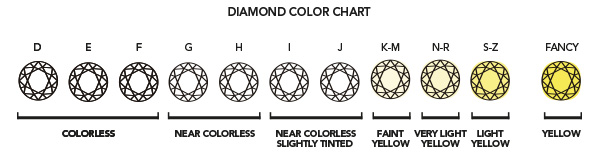
The diamond colour grading system is a scale from D, colourless or almost colourless (we call it white) to Z. Each grade is represented by a letter. The greater the intensity of the whiteness, the higher the value of the diamond: the least valuable diamonds are those with a colouring close to yellow.
Read more
Exceptions to this rule are natural fantasy colours such as pink, blue and red, also known as FANCY COLOR.
CUT
(Taglio)
The charm of a diamond depends more than anything else on how it is cut. The better the diamond is cut at precise angles, the more light can reflect into the stone, enhancing its brilliance. The cut of a diamond has three main characteristics: brilliance (the total amount of light reflected by a diamond), fire (the dispersion of light into the colours of the spectrum), and sparkle.
Read more
The traditional and most commonly used form of cut is the round brilliant cut (Round) with 58 facets. There are also different shapes: oval, marquise, emerald, drop, heart, princess, etc. The cut is rated using a quality scale, which is named below: EXCELLENT, VERY GOOD, GOOD, FAIR, POOR. The same terminology is used to evaluate the SIMMETRY of a diamond's cut and its POLISHING.
CARAT
(Carato)
The carat is named after the carob seed. Because these small seeds have a fairly uniform weight, gem traders used them as counterweights in scales.
The modern metric carat scale of 0.2 grams was adopted by the United States in 1913 and in other countries soon after.
The modern metric carat scale of 0.2 grams was adopted by the United States in 1913 and in other countries soon after.
Read more
Today, one carat weighs exactly the same in every corner of the world. Clearly, the more carats a diamond has, the more the cost increases, not proportionally but exponentially. This is because larger diamonds are rarer and more desirable. However, two diamonds of the same carat can have very different values and very different prices, depending on the other three factors of the 4Cs. For example, 1 carat made up of a single diamond has a very different price to 1 carat made up of 4 diamonds of 0.25 ct.

CLARITY
(Purezza)
Because diamonds are formed at great depths, under extreme conditions of heat and pressure, they often have imperfections that can be internal (inclusions) or external. The clarity of a diamond refers to the absence of these imperfections.
Read more
The clarity assessment is carried out with a 10-magnification lens.
This is why it is always best to consult experts for the accurate evaluation of diamond clarity.
| IF | INTERNALLY FLAWLESS | INTERNALLY PURE |
|---|---|---|
| VVS1/VVS2 | Very Very Slightly Included | Very very small inclusions hardly detectable at 10x |
| VS1/VS2 | Very Slightly Included | Very small inclusions hardly detectable at 10x |
| SI1/SI2 | Slightly Included | Small inclusions easily detectable at 10x |
| P1-2-3 | Imperfect | Inclusions easily detectable even with the naked eye that can affect transparency and glossiness |
FLUORESCENCE
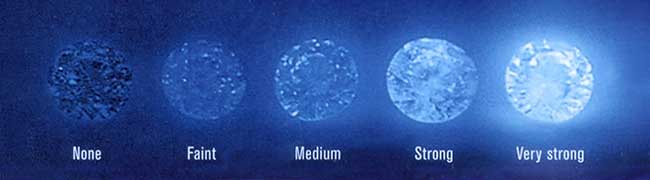
Diamonds subjected to ultraviolet radiation (366 nm) can give rise to fluorescence, which generally manifests itself as blue-blue colours of varying intensity.
The high intensity of the phenomenon affects the colour of the diamond.
The high intensity of the phenomenon influences the colour of the gem; this effect of fluorescence is a physical characteristic of the diamond and is absolutely stable.